
Minimum order value vs minimum order quantity: which rule should your store use?
A merchant-friendly way to choose between cart value minimums and quantity minimums without confusing buyers or blocking good orders.
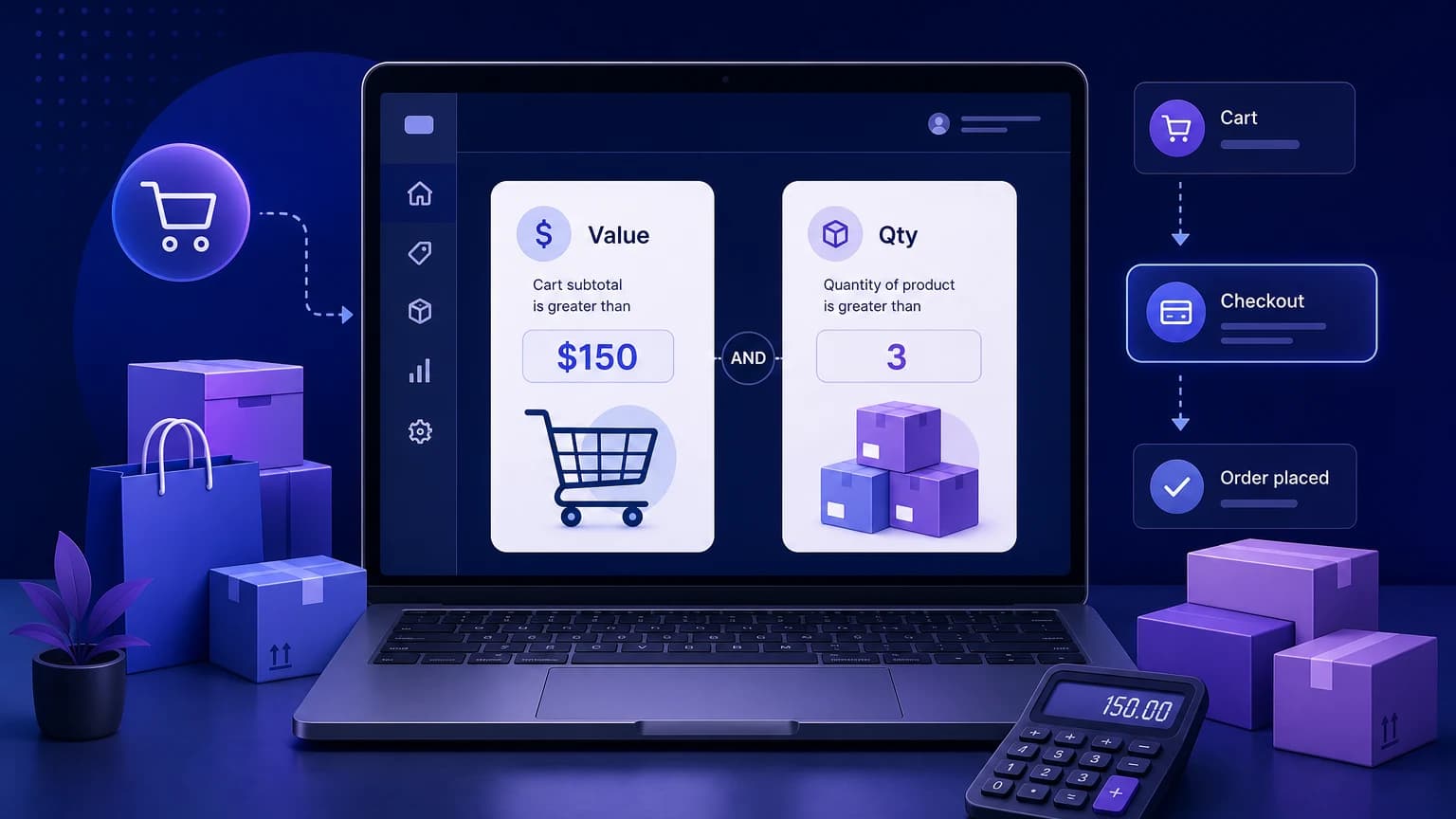
Minimum order value and minimum order quantity both stop orders that are too small. They just solve different problems.
A minimum order value says the cart needs to reach a certain subtotal before checkout. A minimum order quantity says the customer needs to buy enough units. Mix them up and the rule starts to feel random. The buyer gets blocked, support gets the ticket, and the team still has to explain why the order was not allowed.
For Shopify merchants, the better question is not "Which rule is stronger?" It is "What makes this order bad for our store?" If the problem is margin, use value. If the problem is packing, inventory, or wholesale case size, use quantity.
The short version
Use minimum order value when the order is not worth processing below a certain subtotal.
Use minimum order quantity when units matter more than dollars.
That sounds obvious, but it gets messy fast. A $40 order can be fine if it is one high margin item that ships in a padded mailer. A $400 order can still be wrong if it contains 11 units of a product that ships only in cases of 12.
Here is the practical split.
| Store problem | Better rule | Example |
|---|---|---|
| Small orders lose money after picking, packing, and payment fees | Minimum order value | Cart subtotal must be at least $75 |
| Products ship in cartons or case packs | Minimum order quantity or multiples | Buy in packs of 6 or 12 |
| Wholesale buyers need to meet account minimums | Minimum order value, sometimes with MOQ | Wholesale cart must be at least $300 |
| Samples are being abused | Quantity maximum plus value minimum | Max 1 sample per SKU, cart must include a paid item |
| A collection should be bought in enough volume | Collection MOQ | Buy at least 24 units from the wholesale snack collection |
When minimum order value makes more sense
Minimum order value is about the economics of the whole cart.
Use it when your team does not care which exact units the customer buys, as long as the order is large enough to cover the work behind it. This is common for stores with low average item prices, manual packing, cold-chain handling, wholesale accounts, or shipping materials that cost the same whether the cart contains one item or five.
A few examples:
- A specialty food store does not want to ship a $9 jar by itself.
- A wholesale stationery store needs each order to clear $250 before the pick list makes sense.
- A beauty brand allows samples, but only when the cart includes enough regular products.
- A store with local delivery wants the cart to reach $50 before offering delivery.
The rule is easy for customers to understand if the copy is direct:
Add $18 more to reach the $75 minimum order value.That is better than a vague message like "Your cart does not meet store requirements." Buyers should know what to do next without opening a support chat.
When minimum order quantity makes more sense
Minimum order quantity is about units.
Use it when the number of items creates the operational rule. That may be because of carton size, case packs, manufacturing batches, wholesale agreements, or product handling.
Examples:
- A candle brand ships wholesale cases of 6.
- A beverage store sells cans by 12-pack.
- A printer needs at least 50 units for a custom label run.
- A B2B store requires at least 24 units from a collection.
In these cases, cart value alone will not protect the operation. A customer may spend enough money and still choose the wrong unit count.
For example, if a product ships in cases of 12, a cart with 11 units is still a problem even if the subtotal is high. The warehouse has to break a case, repack units, or make an exception. That is exactly the kind of thing a quantity rule should catch before checkout.
Do not use value rules to fix carton problems
This is where many stores create weird buying experiences.
A merchant wants customers to buy full cases, but sets a minimum cart value instead. It works sometimes, but not cleanly. If the product price changes, the rule drifts. If the buyer mixes expensive and cheap items, the cart may pass the value rule while still leaving broken cases in the warehouse.
For case packs, use quantity multiples:
This product ships in cases of 12. Add 5 more units or reduce the quantity to 12.If you only need a minimum, use MOQ:
Wholesale orders for this product start at 24 units.The point is to match the rule to the real constraint. Customers are more patient with limits when the limit makes sense.
Do not use MOQ to fix low margin carts
The opposite mistake is just as common.
A store sets "minimum 5 items" because small orders are not profitable. But the catalog has a mix of $4 accessories and $80 products. Now a customer buying one $160 item gets blocked, while another customer buying five cheap add-ons gets through.
That is not a quantity problem. It is a cart value problem.
If profitability is the reason, use minimum order value. You can still add product-specific MOQ where it matters, but do not make unit count carry a job it was not built for.
Where Shopify merchants need to be careful
Shopify's default setup may not cover every specific minimum value, MOQ, customer tag, collection, or cart validation rule a merchant wants. Some themes can show messages. Some custom code can change quantity selectors. That does not always mean the cart is protected everywhere a buyer can update it.
Check the surfaces that customers actually use:
- Product page quantity selector
- Quick add buttons
- Cart drawer
- Cart page
- Bundle or subscription app flows
- Checkout entry point
- Mobile layout
If the rule matters, test an invalid cart all the way to checkout. A warning on the product page is not enough if the buyer can bypass it from the cart drawer.
With Nexo Order Limits, merchants can create value, quantity, maximum, multiple, product, collection, and customer tag rules in one place. That is useful when the store needs both retail and wholesale behavior without scattering checks across theme files.
A clean rule planning worksheet
Before building the rule, write four plain sentences.
Bad order: A wholesale buyer orders 7 units of a product that ships in cases of 6.
Reason: The warehouse has to break a case.
Rule: Quantity must be a multiple of 6.
Message: This product ships in cases of 6. Choose 6, 12, 18, or another multiple.
For value minimums:
Bad order: A customer checks out with a $14 cart.
Reason: Packing and shipping work eats the margin.
Rule: Cart subtotal must be at least $50.
Message: Add $36 more to reach the $50 order minimum.
This little worksheet catches most bad rules before they go live. If you cannot explain the reason in one sentence, the buyer probably will not understand it either.
Can a store use both rules?
Yes. Many stores should.
A B2B food store might require a $300 minimum order value and also require certain products to be bought by the case. A sample program might require a regular paid item in the cart and limit samples to one per SKU. A distributor portal might set a minimum value for the whole order, then multiples for heavy or fragile products.
The trick is not to pile rules on top of each other without a reason. If a cart fails, the message should tell the buyer which rule failed first and how to fix it.
Bad:
Your cart does not meet requirements.Better:
Add $42 more to reach the wholesale order minimum.Or:
Protein bars ship in cases of 12. Change the quantity to 12 or 24 to continue.How to roll it out without annoying customers
Start with the rule that has the clearest operational reason. Usually that means wholesale minimums, case packs, or low-value carts that are obviously unprofitable.
Then watch what happens. If customers keep failing the rule, the problem may not be the limit. It may be the wording, where the message appears, or a product page that hides the pack size until too late.
A simple rollout:
- Add the rule to one product, collection, or customer group.
- Put the message near the quantity selector or cart summary.
- Test a passing cart and a failing cart.
- Test mobile.
- Ask support to save confusing customer messages for the first week.
- Adjust the copy before adding more rules.
This is not glamorous work. It is the part that keeps a good operational rule from becoming a conversion problem.
FAQ
Is minimum order value the same as minimum order quantity?
No. Minimum order value checks the cart subtotal. Minimum order quantity checks the number of units. A store may need one, both, or neither depending on the problem behind the rule.
Which rule is better for wholesale on Shopify?
Wholesale stores often use minimum order value for account profitability and quantity rules for case packs. For example, the cart may need to reach $300, while certain SKUs must be bought in cases of 12.
Can Shopify set minimum order value by default?
Some Shopify setups can show minimum order messages or use custom code, but the default setup may not enforce every cart, product, collection, or customer group rule. If the minimum must block checkout, test the full path before relying on it.
Can I set different minimums for retail and wholesale customers?
Yes, if your setup supports customer tags or customer segments. A common pattern is no minimum for retail buyers, then higher value or quantity minimums for customers tagged wholesale or distributor.
What should the error message say?
Say what failed and what the buyer should do next. "Add $18 more to reach the $75 minimum" is clearer than "Cart validation failed." For quantity rules, mention the exact unit count or pack size.