
Different order rules for retail and wholesale customers on Shopify
How to separate retail and wholesale order rules on Shopify without making normal shoppers follow warehouse rules.
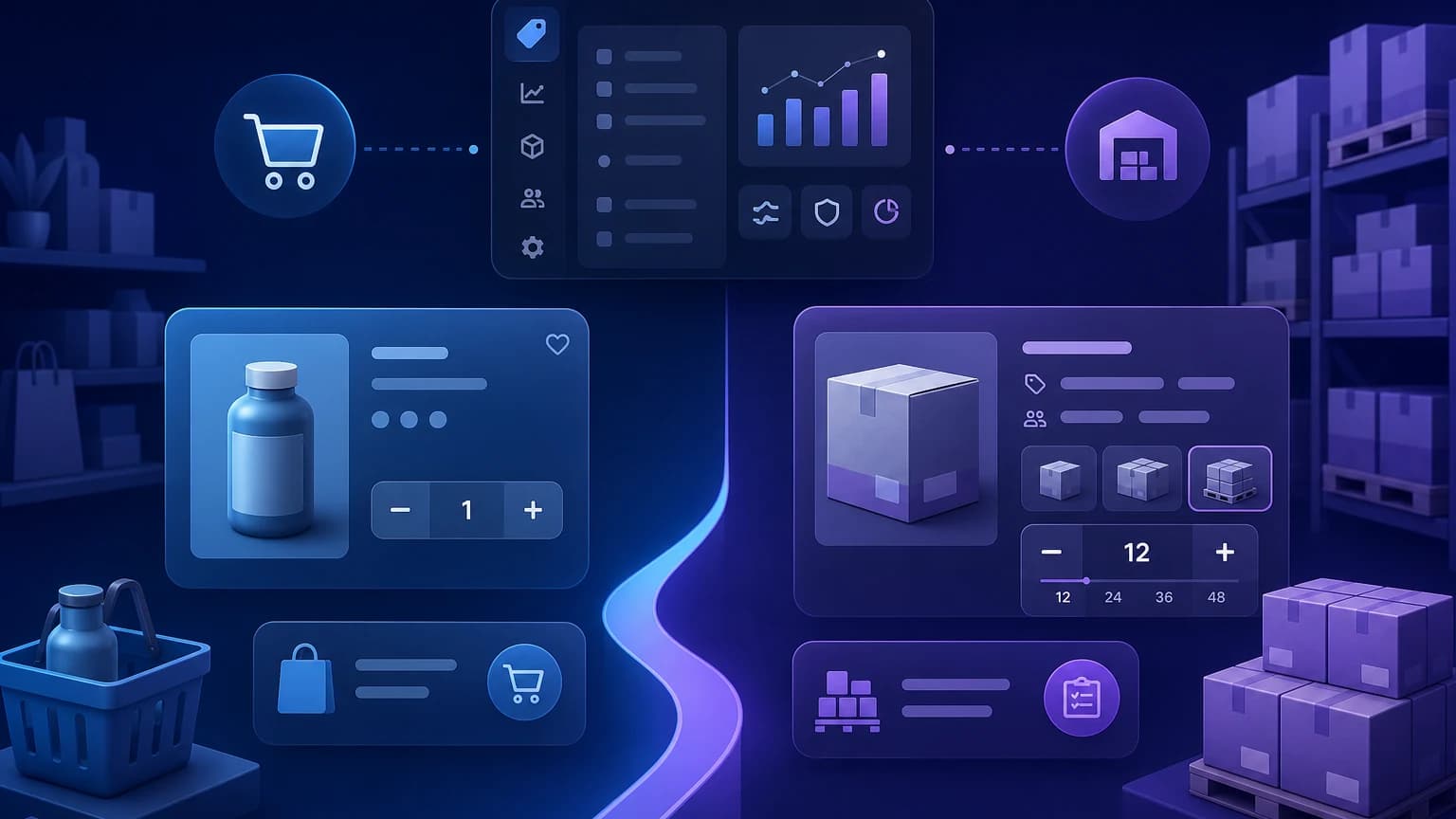
Retail and wholesale carts can look like the same checkout problem. They are not.
A retail shopper may want one candle, one replacement filter, or two bags of coffee. A wholesale buyer may need a full case, a minimum cart value, or a cap tied to their account. If both groups get the same rule, someone usually has a bad day.
The trick is not to make the rule stricter. It is to make the rule belong to the right buyer.
Start with the buying behavior
Before touching settings, write down how each customer type should buy.
Retail buyer: can buy single units.
Wholesale buyer: must buy by case pack.
Distributor: must meet a higher minimum order value.
That short note prevents a common mistake: turning an internal wholesale policy into a sitewide restriction.
For example, a store that sells skincare might have this setup:
Retail customers: minimum 1 unit.
Wholesale customers: minimum 24 units per order.
Wholesale lip balm: order in multiples of 12.
Distributor accounts: minimum cart value $500.
Those are different rules because the customers create different work. Retail orders need to stay easy. Wholesale orders need to fit packing, account terms, and inventory planning.
Retail rules should stay light
Retail order rules are usually there to stop edge cases.
Good retail rules might include:
- A maximum quantity on limited edition products.
- A minimum cart value if small orders lose money.
- A limit on sample products.
- A quantity cap on products that attract hoarding during a drop.
Most retail shoppers are not thinking about case packs or warehouse efficiency. If the storefront suddenly says they must buy 12 units, it feels broken unless the product is clearly sold as a pack.
A retail rule should answer one question: does this restriction protect the customer experience or the store's economics without making normal buying feel strange?
If the answer is no, the rule probably belongs to wholesale customers only.
Wholesale rules can be stricter, but they need a reason
Wholesale buyers expect more structure. They may already know your case packs, opening order minimum, reorder minimum, or account tier.
Common wholesale rules include:
- Minimum cart value for approved wholesale accounts.
- Minimum product quantity for wholesale-only SKUs.
- Quantity multiples for cartons, trays, sleeves, or inner packs.
- Maximum quantity for limited stock sold across several accounts.
- Different limits for
wholesale,vip-wholesale, anddistributorcustomers.
The important part is not the label. It is the operational reason behind the rule.
A case pack rule exists because the warehouse ships in cases. A minimum order value exists because handling a tiny wholesale order may not be worth the pick, pack, invoice, and support work. A purchase cap exists because one buyer should not drain inventory meant for several accounts.
When the reason is clear, the cart message becomes easier to write.
Do not use one global rule unless both groups need it
A global rule applies to everyone. Sometimes that is fine.
All customers can buy at most 1 limited edition jacket.That rule may make sense for a launch where every shopper should have the same limit.
But this rule is different:
All customers must buy coffee in multiples of 12.That might be perfect for wholesale cases and terrible for retail. A normal shopper trying to buy one bag will not care that the warehouse shelf is arranged in cases of 12.
If retail and wholesale buyers need different behavior, split the rule by customer type, customer tag, company account, market, or another signal your setup can rely on.
Decide how Shopify will identify the buyer
Customer-specific rules only work when the store can tell who is buying.
Depending on the setup, that signal might be:
- A Shopify customer tag such as
wholesale. - A B2B company account.
- A customer segment managed by your team.
- A market, location, or sales channel condition.
- A logged-in account tied to approved wholesale status.
Shopify's default setup may not cover every retail-versus-wholesale rule by itself, especially when the rule depends on tags, quantity multiples, cart value, or the customer's login state. Test the exact path your buyers use before treating the rule as finished.
The awkward case is the logged-out wholesale buyer. The store may not know they are wholesale yet. You need to decide what happens then:
Option A: show retail behavior until sign-in.
Option B: ask wholesale buyers to sign in before shopping.
Option C: allow browsing, then apply wholesale rules in the cart after sign-in.
None of those is universally right. The wrong choice is leaving it undefined and discovering it through support tickets.
Keep product rules and customer rules separate in your notes
A product rule follows the item.
This product must be ordered in multiples of 6.A customer rule follows the buyer.
Wholesale customers must spend at least $300.A cart rule follows the whole cart.
The cart must contain at least 24 total wholesale units.Stores get messy when these ideas are mixed together. Someone adds a product multiple, another person adds a customer tag rule, and a third person changes the cart minimum. A month later nobody knows why one customer can buy 6 units while another has to buy 12.
Write the rules in a small table before configuring them.
| Rule | Applies to | Example |
|---|---|---|
| Retail max quantity | Product and all customers | Max 1 limited item per order |
| Wholesale MOQ | Customer tag | Wholesale customers must buy at least 24 units |
| Case pack multiple | Product or variant | Buy bottles in multiples of 12 |
| Distributor minimum value | Customer tag or company | Distributor cart must reach $500 |
The table does not need to be fancy. It just needs to be boring enough that the next person can understand it.
Write messages like a buyer is trying to fix the cart
Bad rule messages sound like admin errors.
Cart validation failed.Better messages tell the buyer what to do.
Wholesale orders require a $300 minimum. Add $42 more to continue.This product ships in cases of 12. Change the quantity to 12, 24, or 36.This launch is limited to 1 per customer.The message should match the rule and the buyer. Retail copy can be short and plain. Wholesale copy can reference case packs, opening orders, or account terms because those buyers are more likely to understand them.
Do not show internal tags to customers. "Customer does not match tag wholesale-tier-b" may be technically useful for debugging. It is not useful to a buyer.
Test both customer paths
Do not test only the happy path. Retail and wholesale rules fail in the gaps between account state, cart state, and checkout.
Use a checklist like this:
- Logged-out retail visitor buying one unit.
- Logged-in retail customer with no wholesale tag.
- Logged-in wholesale customer below the minimum.
- Logged-in wholesale customer at the exact minimum.
- Wholesale customer adding a non-case quantity.
- Distributor account with a higher cart minimum.
- Customer with two tags that could match two rules.
- Mobile cart drawer quantity changes.
- Quick add from a collection page.
- Buyer signing in after items are already in the cart.
That last one is where many setups feel rough. The buyer builds a cart as retail, signs in, and suddenly the cart has wholesale rules. If that is expected, the message should make it clear. If it is not expected, fix the flow before launch.
Where Nexo fits
Nexo Order Limits can help merchants run different order rules by product, cart value, quantity, multiples, and customer conditions such as tags.
That does not mean every store should pile on rules. Start with the policy you already use offline. If wholesale buyers must buy by case, enforce the case pack. If distributors have a higher minimum, apply that minimum to the right accounts. Keep retail shoppers out of rules that were never meant for them.
FAQ
Can Shopify have different order rules for retail and wholesale customers?
Yes, if your setup can identify the customer type and apply the right validation. Customer tags, company accounts, customer segments, or an order limits app may be part of that setup. Shopify's default setup may not cover every version of this by itself, so test it with real customer states.
Should wholesale customers have a higher minimum order value?
Often yes, but it depends on how you handle wholesale orders. If a small wholesale order creates extra packing, invoicing, or support work, a higher minimum can make sense. If wholesale orders are fulfilled the same way as retail, the rule may not be needed.
Can retail customers buy singles while wholesale customers buy cases?
Yes, that is a common pattern. The rule needs to know when the buyer is wholesale, then enforce quantity multiples or case packs only for that buyer group.
What happens if a wholesale buyer is not logged in?
The store may treat them like a retail shopper until it can identify the account. Decide whether wholesale buyers must sign in before shopping or whether the cart updates after sign-in. Either way, test the transition.
Should I use customer tags or product rules?
Use customer tags when the rule depends on who is buying. Use product rules when the restriction belongs to the item itself. Many wholesale stores need both: a product might ship in cases of 12, but only wholesale buyers have to follow that case rule.